

Estimate Pi with the Monte Carlo method and a neotrinkey
The power of randomness can be harnessed! Estimating the area of a circle by throwing darts at random gives you the means to estimate the value of Pi! I first learned about using the Monte Carlo back in the '80's and even used it in software development to estimate timing of events. You can use it with you NeoTrinkey to estimate the valueof Pi. You can find my github repository here: https://github.com/mrklingon/PieceOfPi/
Monte Carlo methods are a broad class of computational algorithms that rely on repeated random sampling to obtain numerical results. One of the basic examples of getting started with the Monte Carlo algorithm is the estimation of Pi. (https://www.geeksforgeeks.org/estimating-value-pi-using-monte-carlo/)
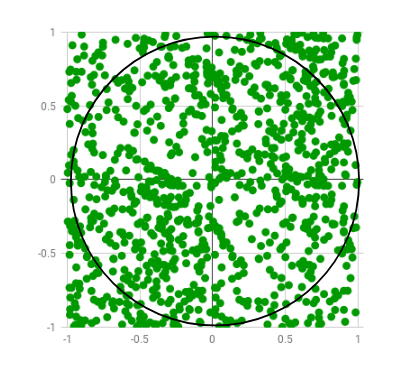
This project iterates over a unit circle of radius one and "throws" darts at random from -1 to 1 x, and -1 to 1 y, then counts how many land IN the circle. Pi is estimated by multiplying 4 * "darts inside circle"/all darts thrown
The more iterations (darts) thrown, the closer you approach the value of Pi.
The program runs continuously, pausing 5 seconds between runs. While the program is running/estimating, the neopixels flash random colors. When it finishes an estimate, the neopixel displays the answer by blinking the neopixels green for the value (three times for three, one time for one and so on.). Zeroes are indicated by turning all pixels pink briefly. The pixels flash blue to indicate the decimal point.
If the program is run inside a REPL like Mu, it will print out the results:
 I will estimate Pi.
it is around : 3.14139
I will estimate Pi.
it is around : 3.13818
I will estimate Pi.
it is around : 3.13422
I will estimate Pi.
it is around : 3.1313
The default value of Iterations is 100 - you can change that to higher or lower values.
Files
- findPi.py - copy to code.py to run
- ncount.py - helper file, provides color definitions and blinknum() to blink the digit values.
For more about the Monte Carlo Method: https://en.wikipedia.org/wiki/Monte_Carlo_method
This page (Piece Of Pi with a NeoTrinkey!) was last updated on February 17, 2025.